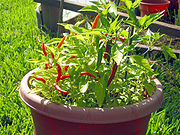
 The Cayenne, or Guinea pepper, or Bird pepper is a red, hot chili pepper used to flavor dishes and for medicinal purposes. Named for the city of Cayenne in French Guiana, it is a cultivar of Capsicum annuum related to bell peppers, jalapeños, and others. The Capsicum genus is in the nightshade family (Solanaceae).
 The fruits are generally dried and ground, or pulped and baked into cakes, which are then ground and sifted to make the powdered spice known as cayenne pepper.
Cayenne is used in cooking spicy hot dishes, as a powder or in its whole form (such as in Sichuan cuisine) or in a thin, vinegar-based sauce. It is generally rated at 30,000 to 50,000 Scoville Units. It is also used as a herbal supplement, and was mentioned by Nicholas Culpeper in his book Complete Herbal.
Cayenne pepper is considered to be misnomer by the American Spice Trade Association, which prefers the more generic term red pepper. Generally speaking any of a number of peppers are called cayenne.Most cultivated varieties of Cayenne Capsicum annuum can be grown in a variety of locations and need approximately 100 days to mature. Peppers prefer warm, moist, nutrient-rich soil in a warm climate. The plants grow to about 2–4 feet of height and should be spaced three feet apart.
Chilis are mostly perennial in sub-tropical and tropical regions however they are usually grown as annuals in northern climates. They can be overwintered if protected from frost and require some pruning.Cayenne is a popular spice in a variety of cuisines. It is employed variously in its fresh form, dried and powdered, and as dried flakes. It is also a key ingredient in a variety of hot sauces, particularly those employing vinegar as a preservative.
Cayenne contains a pungent resin-like substance known as capsaicin. This chemical, the active ingredient of pepper spray or mace, relieves pain and itching by affecting sensory nerves. Capsaicin temporarily causes various neurotransmitters to release from these nerves, leading to their depletion. Without the neurotransmitters, pain signals can no longer be sent. The effect is temporary.
Cayenne (Capsicum frutescens or Capsicum annuum)is a Flavon (USDA reference http://www.nal.usda.gov/fnic/foodcomp/Data/Flav/Flav02-1.pdf page 68) and as such is a vasodilator (page 1 same reference) (it causes your blood vessels to open).
Capsaicin, potentially derived from Cayenne Pepper, is used in the production of pepper spray, as employed by police, military, and security personnel.
Scoville Rating: 30000-50000